There was a time in my life when going to the supermarket stopped being routine and started feeling like pressure.
If you’re trying to organize your finances when money is tight, this story might feel familiar.
I remember standing in the cookie aisle, staring at the shelves, doing silent math in my head.
Not today.
“It has to be bread and butter for their school lunch.”
Not because I didn’t want to give my kids more.
Not because they didn’t deserve more.
But because there simply wasn’t room in the budget.
And that was the moment I realized this wasn’t just a money problem anymore.
It was emotional.

When Money Isn’t Enough — Even When You’re Doing Everything “Right”
We were working.
We weren’t living above our means.
We weren’t going on luxury vacations or buying expensive things.
And still, the money didn’t stretch.
The electricity bill was always a looming fear.
Groceries felt like a strategic mission.
Buying something for myself wasn’t even something I considered.
There’s something else that mattered deeply to me: independence.
I have never liked asking my parents for help.
I’ve always wanted to manage my own life, my own family, on my own.
So I cut from myself first.
No extras for me.
No small treats.
No unnecessary spending.
If anyone had to go without, it was me.
But even then, our savings kept shrinking.
And I felt myself shrinking with them.
It wasn’t just about the numbers in the bank account.
It was the constant feeling of failing quietly.
The Silent Guilt No One Talks About
If you have children, you understand this.
You can sacrifice everything for yourself without hesitation.
But when you feel like you’re coming up short for your kids… that hits differently.
They weren’t going hungry.
But everything lived at the bare minimum line.
School lunches had to be the simplest option.
Unexpected expenses felt like threats.
Anything “extra” felt irresponsible.
And layered on top of that was something else: time.
I wanted to earn more.
But I had my kids.
I couldn’t magically add hours to my day.
I felt trapped between two harsh realities:
- I couldn’t keep living like this.
- But I couldn’t see a way out either.
That feeling of being stuck — that’s what wears you down.
The Day I Stopped Avoiding the Truth

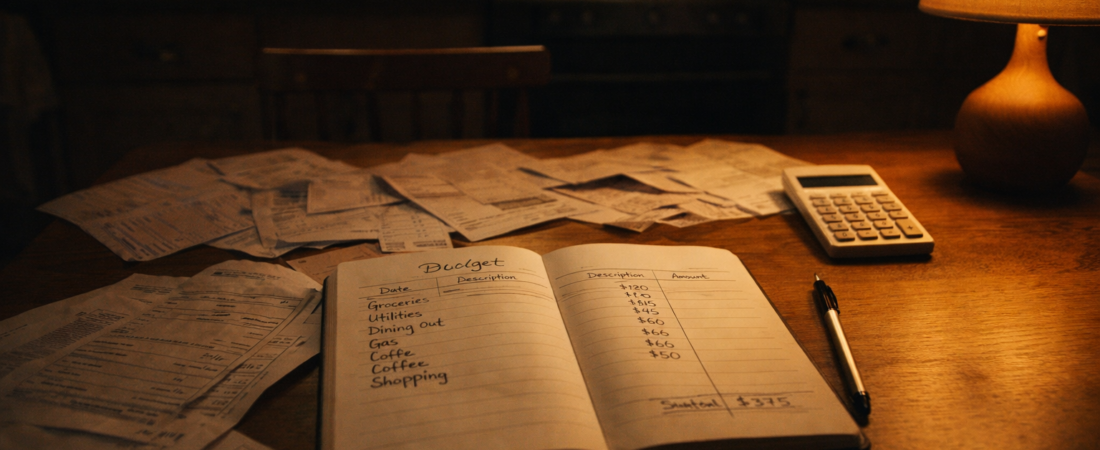
One evening, I sat at the kitchen table with a pen and a notebook.
There was no dramatic fight.
No financial catastrophe that day.
Just exhaustion.
And a quiet realization:
I didn’t actually know where our money was going.
I knew it was disappearing.
But I didn’t know how.
That was uncomfortable.
But it was also the turning point.
Because I realized something simple and powerful:
I couldn’t control how much we earned at that moment.
But I could control how we managed it.
The First Step: Radical Honesty
For a long time, I thought I had a general idea of our expenses.
But “a general idea” is not enough when you’re barely staying afloat.
So I started with the most basic step possible:
I wrote everything down.
- Every expense.
- Every coffee.
- Every grocery run.
- Every automatic payment.
No judgment.
Just numbers.
At first, it was uncomfortable.
It’s hard to see how small, frequent expenses add up.
It’s hard to realize how much leaks out unnoticed.
But for the first time in months, I felt a sense of control.
And control brings relief.
I Didn’t Make More Money — I Organized Better
I didn’t suddenly get a higher-paying job.
I didn’t win the lottery.
I didn’t discover some secret financial hack.
I organized.
And that made more difference than I ever expected.
1. I Started Planning Weekly Meals
Instead of going to the supermarket and “seeing what we needed,” I started planning.
I decided our meals for the week before leaving the house.
I wrote a precise list.
And I stuck to it.
No wandering through aisles.
No spontaneous additions.
This reduced waste.
It reduced impulse purchases.
It reduced extra trips to the store.
And most importantly, it reduced anxiety.
2. I Focused on Necessary — Not Desirable
I had to be brutally honest with myself.
It wasn’t the season for experimenting with expensive recipes.
It wasn’t the season for “just in case” purchases.
Before putting anything in the cart, I started asking:
“Is this truly necessary?”
That one question changed our spending patterns.
3. I Stopped Counting on 100% of Our Income
If we earned 1,000, I built our month around 900.
The remaining portion became untouchable.
At first, it was small.
Sometimes very small.
But that buffer became a psychological anchor.
It gave us breathing room.
The Lesson No One Had Taught Me
We had no system.
When there’s no structure, money disappears silently.
When there’s no plan, every unexpected bill feels catastrophic.
When there’s no clarity, anxiety fills the gap.
Organization didn’t instantly make us wealthy.
But it gave us dignity.
It gave us clarity.
It gave us peace.
Why I’m Sharing This
I know there are families living exactly in that stage right now.
The stage where the numbers don’t quite work.
The stage where supermarket decisions feel heavy.
The stage where you cut from yourself to protect your children.
If that’s you, I want you to hear this:
Organization won’t solve everything.
But it changes everything.
It doesn’t create miracles overnight.
But it restores control.
And control restores dignity.
If you’re in your own “bread and butter season,” know this:
You are not failing.
You might just need structure.
And that’s exactly where I started.